The Compute Contract: From On-Demand Terms to Take-or-Pay
A GPU-hour is sold under one of three kinds of paper: published terms of service, reserved commitments of a month to a year, and negotiated multi-year agreements. This primer walks the spectrum using the primary documents.
01 One Asset, Three Kinds of Paper
The same accelerator earns under very different contracts depending on who is renting it and for how long. The rate cards CCIR tracks are the posted-ask layer of this spectrum: on-demand rates and committed asks by tenor (/term). The persistent gap between the two ends is measured in The Commitment Discount. What follows is the contractual machinery behind those postings.
- Pay for hours consumed; stop anytime
- Not guaranteed; interruptible tiers exist
- Published terms of service, accepted rather than negotiated
- Pay for the reservation whether used or not
- Guaranteed for the term
- Order form under standard terms
- Fixed payments independent of usage; upfront payment common
- Dedicated clusters; hardware-failure and service-level agreement (SLA) relief
- Negotiated master services agreement + order forms
02 The On-Demand End: Published Terms
At the retail end there is no negotiation. The contract is a document on the provider's website, accepted at account creation. CoreWeave's Terms of Service (last modified June 30, 2022) is representative and published in full, with an Acceptable Use Policy, Data Processing Agreement, and Privacy Policy incorporated by reference. The commercial mechanics are ordinary trade credit. Invoices under $20,000 are charged to the customer's card. Invoices of $20,000 or more are payable by automated clearing house (ACH) or wire on Net 15 terms. Unpaid balances accrue a finance charge of 1.5% per month. Non-payment carries an operational remedy, suspension of application programming interface (API) access:
“CoreWeave reserves the right to deactivate, terminate, prevent access to, disable services for, and/or suspend or delete a Customer's account or access to any CoreWeave Services at any time for nonpayment, late payment… If any amount of your Fees are past due, we may suspend your API access after we provide you written notice of late payment.”
“Any amounts due under this Agreement shall not be withheld or offset by you against amounts due to you for any reason.”
Basis
Source: docs.coreweave.com, retrieved 2026-07-09.Marketplace venues sit at the same end with a different seller: on a marketplace the machines are listed by independent hosts, billing runs per second, and there is no capacity commitment in either direction. This is the fully interruptible, no-commitment end of the spectrum. The prices posted here are the on-demand series in the published rates, and the live marketplace venues in the basis monitor.
03 The Committed End: The Master Services Agreement
The committed end runs on a two-layer architecture. The master services agreement is the frame: definitions, service obligations, payment mechanics, termination rights. The commercial substance (chips, quantities, prices, dates) lives in order forms executed under it. CoreWeave's MSAs with Microsoft, OpenAI, and NVIDIA are filed on EDGAR. The order forms are not. Within the filed MSAs the registrant's redactions, marked [*], fall almost exactly where the commercial terms sit. The legal architecture is fully readable.
| Counterparty | Signed | Filed as | Notable clause |
|---|---|---|---|
| Microsoft | Feb 22, 2023 | Ex. 10.23, Form S-1 (Mar 2025) | Take-or-pay termination mechanics with remarketing offset; 2-day hardware-failure payment relief |
| NVIDIA | Apr 10, 2023 | Ex. 10.31, Form S-4/A (Sep 2025) | Capacity cap on NVIDIA’s own usage: the “[*] Rule,” size redacted |
| OpenAI | Mar 7, 2025 | Ex. 10.24, Form S-1/A (Mar 2025) | Substitute-operator assignment right; “Reportable Event” payment-distress covenant; $350M initial public offering (IPO) share issuance |
| OpenAI (second) | May 8, 2025 | Ex. 10.32, Form S-4/A (Sep 2025) | Separate later agreement; same bare-metal architecture |
CoreWeave, Inc. (SEC Central Index Key, or CIK, 0001769628) exhibit filings. Counterparty links open the filed exhibit as verified on 2026-07-09.
The frame itself is compact. The Microsoft agreement runs thirteen sections, and the finance-relevant machinery concentrates in four:
| § | Section, as filed | What it carries |
|---|---|---|
| 1 | Definitions | The units of the deal: Order Form, Reserved Instances, Bulk Credits, Hardware Failure. Everything downstream is built from these. |
| 2 | Services | Access to the reserved capacity and the ordering mechanics. In the NVIDIA agreement, this is where the capacity-cap “[*] Rule” lives. |
| 3–7 | Responsibilities · Data · IP · Confidentiality · Reps | Use restrictions, data processing, licenses, and the confidentiality clause that keeps order forms out of the public record. |
| 8–9 | Limitation of Liability · Indemnification | Damages caps and consequential-damages waivers: the ceiling on what a service failure can cost the operator. |
| 10 | Term and Termination | Cure periods, insolvency triggers, and the remarketing-and-damages formula quoted below: the take-or-pay skeleton. |
| 11 | Payment of Fees | Net terms and early-payment discounts (percentages redacted), billing in arrears for on-demand use, no-offset mechanics. |
| 12 | Availability of Service | SLAs and the hardware-failure clause: two consecutive business days of failure suspends the payment obligation. |
| 13 | General | Assignment and governing law: the section any lender's collateral assignment, or a substitute operator, must pass through. |
Section titles as filed in Ex. 10.23. Groupings 3–7 and 8–9 condensed. The OpenAI and NVIDIA agreements follow the same skeleton with counterparty-specific insertions.
Basis
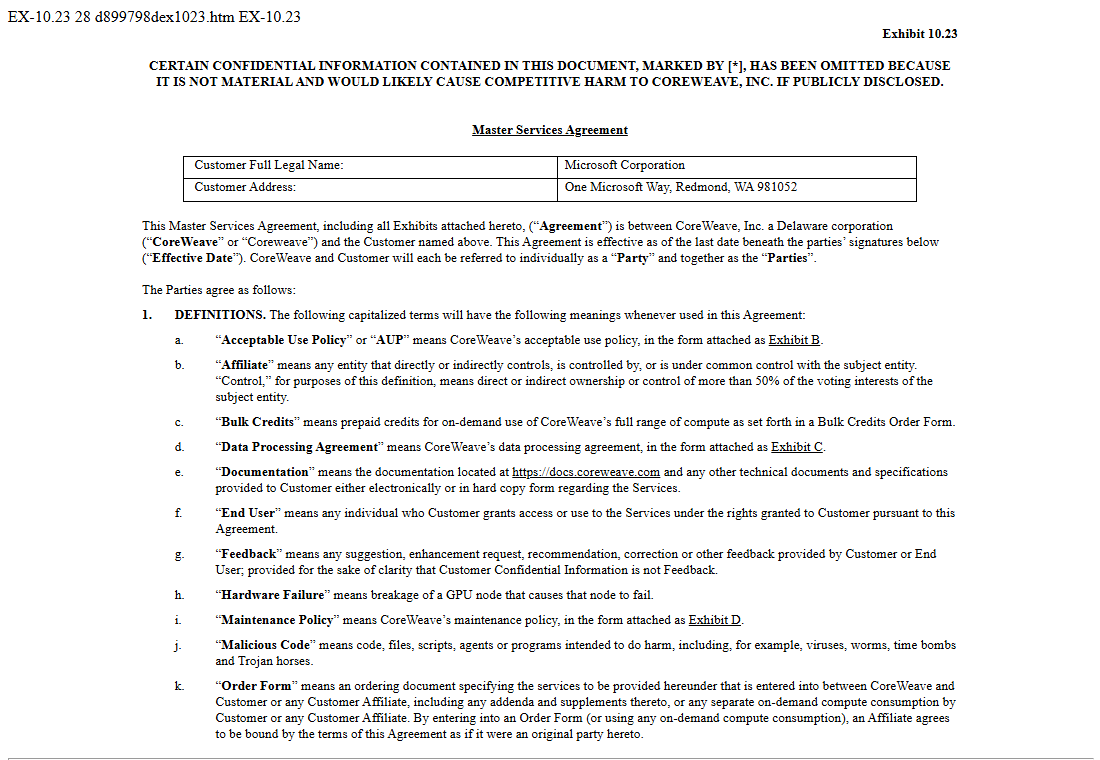
As filed, the first page of the CoreWeave–Microsoft Master Services Agreement (Ex. 10.23). It shows the redaction legend, the counterparty, and the definitions the deal is built from.The defined terms do the structural work. A reservation is exclusive use of hardware, not a quota of usage:
CERTAIN CONFIDENTIAL INFORMATION CONTAINED IN THIS DOCUMENT, MARKED BY [*], HAS BEEN OMITTED BECAUSE IT IS NOT MATERIAL AND WOULD LIKELY CAUSE COMPETITIVE HARM TO COREWEAVE, INC. IF PUBLICLY DISCLOSED.
“Reserved Instances” means the exclusive use of a specified amount and type of compute configuration as set forth in a Reserved Instance Order Form.
“Hardware Failure” means breakage of a GPU node that causes that node to fail.
After Customer accepts Services and receives a proper and undisputed invoice, it will pay Fees and approved expenses… Net 10 days less a [*]% discount on the invoiced amount… or… Net 60 days with [*].
Basis
Source: SEC EDGAR, Ex. 10.23 to CoreWeave's Form S-1, accession 0001193125-25-044231.Payment relief is specified mechanically. Under the Microsoft agreement, if a hardware failure persists for two consecutive business days, the payment obligation for the affected services is canceled until service is restored. Downtime is priced into the contract as suspended rent, not damages. And the termination clause contains the market structure of the committed discount in remedy form. If CoreWeave terminates for the customer's breach, it may remarket the dedicated servers and credit the proceeds against what the customer owes. The customer's exposure is capped at the lesser of the remaining contract fees net of those proceeds, or:
“…then Customer shall pay the lesser of (I) fees due for the remainder of the term minus proceeds from CoreWeave's transfer or sale of the Contract Servers, or (II) from the commencement date of this Agreement through the termination date, the difference between fees paid and fees charged at CoreWeave's on-demand rates.”
Basis
Source: SEC EDGAR, Ex. 10.23. Emphasis added.Read that limb (II) again: a committed customer who walks can be re-rated as if it had bought every hour on demand. The spread between committed and on-demand rates, the commitment discount, is not just a pricing observation. It is the unit in which this contract computes damages.
Two counterparty-specific clauses show how far the negotiated end is from the retail terms. The NVIDIA agreement caps how much of CoreWeave's fleet NVIDIA itself may consume. The size of the cap is redacted, the rule is not: “CoreWeave must not, at any point in time, dedicate more than [*] of available customer capacity to NVIDIA (the ‘[*] Rule’); such capacity being measured by each server type.” The OpenAI agreement obliges the customer to report, in advance, its own projected inability to pay (“a ‘Reportable Event’ occurs when Customer becomes currently unable to or is projected to be unable to, within the next four (4) month period, pay the fees due”). It also pre-arranges a substitute operator: on certain CoreWeave insolvency-type events, the customer may require assignment of the order forms, the agreement, and the applicable data-center agreements to a third-party operator of its choosing, within two business days of notice. The machinery a lender would recognize as servicer-transfer provisions appears here on the customer's side of the table.
04 The Middle of the Market
Between the click-through terms and the negotiated multi-billion MSA sits the middle market: reserved capacity in the tens of millions of dollars. Its paper reaches the public record by two routes: standardized reserved-capacity agreements published in full on providers' sites, and SEC exhibits when one party is a public company small enough for the deal to be material.
The best filed specimen runs in the buying direction. In June 2024, Soluna (a small-cap) contracted with HPE for NVIDIA H100 infrastructure-as-a-service: $34.0 million over 36 months, filed complete as a statement of work with the full services agreement and SLA attached. The mechanics are what a mid-market commitment looks like: an initial pre-payment of $10,293,350.40 (roughly 30% of the deal), a satisfactory credit check as a condition of acceptance, a parent guaranty as credit support, and an express right to resell the capacity onward:
“This SOW will become effective… upon… (c) acceptance of such purchase order by Seller, which will require a satisfactory credit check, and (d) receipt by Seller of the initial pre-payment in the amount of $10,293,350.40 and [***].”
“During the System Term… Purchaser may provide access to the Services to its own customers, who will be considered End Users under the MSA.”
Basis
Source: SEC EDGAR, Ex. 10.105 to Soluna Holdings' Form 10-Q, accession 0001493152-24-032123.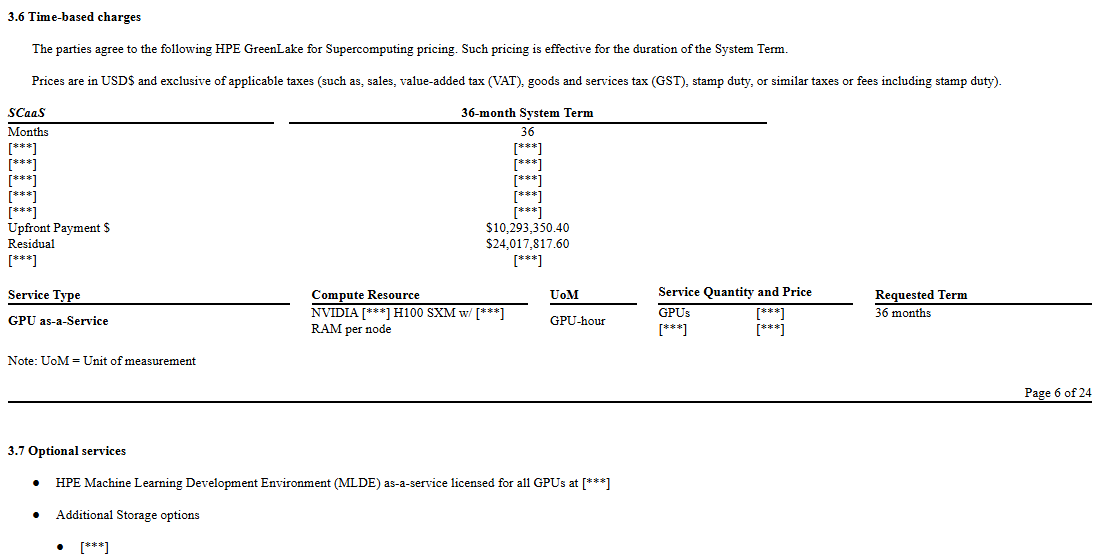
Basis
As filed, the pricing schedule of the Soluna–HPE statement of work (Ex. 10.105, §3.6). GPU-as-a-Service, unit of measure the GPU-hour, 36-month term, rates redacted [***] with the upfront payment and remaining balance left in.The record even carries the deal's full life: the agreement was terminated by 8-K in March 2025. Signing, prepayment, guaranty, termination: a complete mid-market compute commitment, end to end, in public documents.
The published templates carry the same economics in click-through form. Voltage Park's Compute Services Agreement fixes fees “at the price quoted at the time of purchase, for the Term of the applicable Order,” provides that “payment obligations are non-cancelable and, unless otherwise specified, Fees paid are non-refundable,” and charges 1.5% per month on late amounts, the same finance charge as the retail terms in §02. It also lets the customer “terminate any Order for convenience at any time through our website”: the termination button exists, and the payment obligation survives it. Nebius's published services agreement defines a “Committed Volume of Services” payable “regardless of whether actual consumption is below the committed volume.” And the hyperscalers sell the same shape in standardized units. Amazon Web Services (AWS) Capacity Blocks for ML (machine learning) reserve GPU capacity for one to 182 days, non-cancelable and non-modifiable once purchased. At every size, committed capacity means the same thing: the hours belong to the customer whether used or not.
One pattern in what is not public: smaller operators disclose deal terms generously. Sizes, tenors, and prepayment percentages arrive by press release, but the contract text itself is rarely filed. The Soluna exhibit is the exception. For most of the middle market, the posted rate card and the published template are the observable layer.
05 The Layer Beneath: The Datacenter Lease
A compute contract obliges the operator to run machines somewhere, and that somewhere has its own filed paper. On May 28, 2025, two Applied Digital subsidiaries signed datacenter leases with CoreWeave for the full capacity of two buildings at the Ellendale, North Dakota campus, 250 MW in aggregate. The leases themselves are filed as exhibits, redacted with the same conventions as the MSAs. From the 8-K: each lease runs an initial approximately fifteen-year term with three five-year extension options; expected total contract value is approximately $3 billion for Building 2 and $4 billion for Building 3; the landlord owes customary service levels backed by service-level credits; CoreWeave may terminate an affected lease outright (no termination fee) if specified delivery dates are missed, and may terminate for convenience at any time on notice with a specified termination fee. Applied Digital guarantees its subsidiaries' obligations, and issued CoreWeave a warrant alongside.
Stack the layers and the shape of the market is visible in the paper: a customer's multi-year committed MSA sits on the operator's fifteen-year datacenter lease, which sits on the landlord's power infrastructure. Each layer is longer-dated than the one above it, and each is a contract someone finances. The credit agreements that do so take assignment of exactly these documents, the subject of the companion primer.
REIT: real estate investment trust.
06 What the Record Shows, and What It Withholds
The redactions are permitted by Regulation S-K Item 601(b)(10), and registrants use them consistently: cure periods, discount percentages, capacity caps, and (above all) prices and volumes are omitted as “not material” and competitively harmful. What the filed record establishes is the architecture: how a reservation is defined, when payment stops, who may terminate and at what computed cost, and which documents travel together when an operator is replaced. The commercial terms inside the [*] marks are the part of this market that only posted prices make observable. The series CCIR publishes at /rates are the unredacted layer.
07 Sources
- CoreWeave–Microsoft Master Services Agreement (Feb 22, 2023): Ex. 10.23 to Form S-1, accession 0001193125-25-044231
- CoreWeave–OpenAI Master Services Agreement, Bare Metal Environment (Mar 7, 2025): Ex. 10.24 to Form S-1/A, accession 0001193125-25-052207
- CoreWeave–NVIDIA Master Services Agreement (Apr 10, 2023): Ex. 10.31 to Form S-4/A, accession 0001140361-25-036118
- CoreWeave–OpenAI Master Services Agreement, second (May 8, 2025): Ex. 10.32 to Form S-4/A, accession 0001140361-25-036118
- Soluna–HPE GreenLake Statement of Work, HPC & AI Cloud Services Agreement, and SLA (June 2024): Ex. 10.105 to Soluna Holdings' Form 10-Q, accession 0001493152-24-032123; deal terms per the June 24, 2024 8-K (accession 0001493152-24-024845); termination per the March 28, 2025 8-K (accession 0001641172-25-001318)
- Voltage Park Compute Services Agreement (last revised May 28, 2026): voltagepark.com
- Nebius Services Agreement: docs.nebius.com; AWS Capacity Blocks for ML: AWS documentation
- Applied Digital Form 8-K (June 2, 2025) with Building 2 and Building 3 Datacenter Leases — 8-K body, Ex. 10.1, Ex. 10.2, accession 0001641172-25-013199
- CoreWeave Terms of Service (last modified June 30, 2022): docs.coreweave.com
All excerpts verified against the filed text on 2026-07-09. [*] marks are the registrants' redactions, reproduced as filed. Emphasis, where added, is noted.