The GPU SPV: How Lenders Take Compute as Collateral
The largest GPU financings lend to a special-purpose vehicle that owns the GPUs and holds the customer contract. This primer reads that structure out of CoreWeave's filed credit agreements.
01 The Structure
The pattern, from the DDTL 4.0 filing (March 30, 2026): the borrower is CoreWeave Compute Acquisition Co. VIII, LLC (“CCAC VIII,” an indirect subsidiary of CoreWeave, Inc.), and the $8.5 billion facility exists “primarily to finance capital expenditures required to perform a customer contract, including the acquisition of GPU servers and related infrastructure.” The parent is not the borrower, and in this facility its guarantee is limited to specified “bad acts”. The series varies on this point, and the variation turns out to be informative (§04). Obligations are secured by “substantially all assets of CCAC VIII and its subsidiaries and a pledge of 100% of the equity interests in CCAC VIII held by CCAC VIII Holdco LLC.” A collateral agent (U.S. Bank Trust Company, N.A.) holds the security interests. A depositary bank holds the accounts.
Nor is the shape unique to one issuer. Lambda's April 2024 financing vehicle (up to $500 million, Macquarie-led) was described by the company in the same grammar: “an asset-based structure secured by GPUs and supported by their cash flow generation.”
Composite of the DDTL 2.0–4.0 filings; entity names per DDTL 4.0. The operative security grants live in a Collateral Agreement and a Parent Guarantee and Pledge Agreement that are not separately filed.
02 The Collateral Package
Five elements recur across the filed agreements: (1) a first-priority perfected security interest in substantially all assets of the borrower, the GPU servers above all; (2) a pledge of 100% of the borrower's equity, so lenders can foreclose on the entity, not just the machines; (3) the borrower's rights under the customer contract, including rights to payment; (4) the datacenter lease rights; and (5) control of every bank account. From DDTL 2.0's “Collateral and Guarantee Requirement”:
“(c) the Obligations shall have been secured… by a first-priority security interest… in all the Equity Interests of the Borrower…
(e) the Obligations shall have been secured by a first-priority perfected security interest in substantially all now owned or at any time hereafter acquired tangible and intangible assets of the Borrower…”
Basis
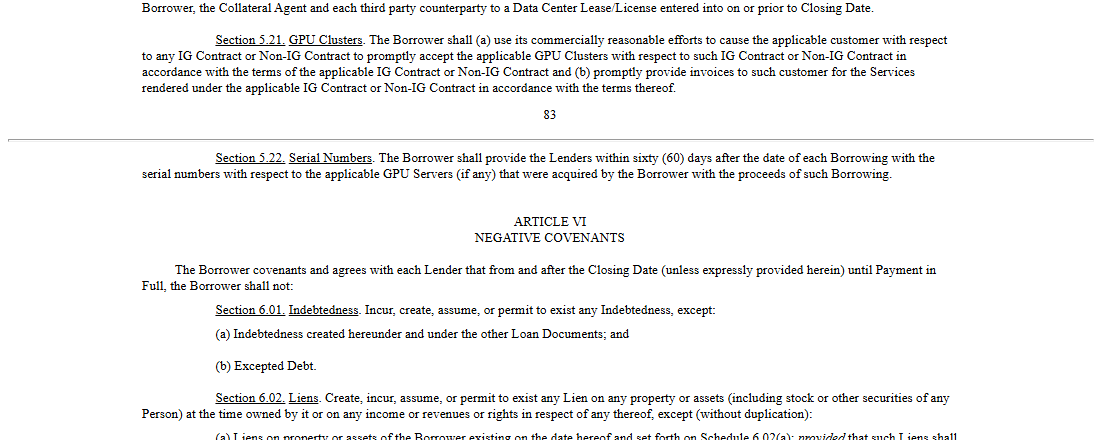
Source: SEC EDGAR, Ex. 10.13 to CoreWeave's Form S-1, accession 0001193125-25-044231.The GPU-specific covenants are the part with no precedent in corporate lending and a long one in equipment finance. The borrower must report the serial numbers of the machines each draw buys and, in the later facilities, pass through the manufacturer's own per-GPU serial documentation:
Basis
As filed: page 83 of the DDTL 2.0 Credit Agreement (Ex. 10.13) — §5.21 GPU Clusters and §5.22 Serial Numbers, between the data-center access covenants and the negative covenants.“(a) The Initial Borrower shall provide the Lenders within sixty (60) days after the date of each Borrowing with the serial numbers with respect to the applicable racks of the GPU Servers that were acquired by the applicable Borrower with the proceeds of such Borrowing. (b) To the extent that any Borrower receives a document from NVIDIA corporation or Dell Marketing, L.P. that lists the serial number of each individual GPU in each GPU Server that constitutes Collateral, the Borrowers shall use commercially reasonable efforts to deliver copies of such document to the Administrative Agent.”
Basis
Source: SEC EDGAR, Ex. 10.1 to CoreWeave's Form 8-K, accession 0001769628-25-000033.Cash is trapped structurally rather than by covenant alone: every deposit account of the borrower must sit under a control agreement “sufficient to establish the Collateral Agent's control pursuant to Section 9-104 of the UCC” (the Uniform Commercial Code). Collections are directed into named collateral accounts: an Available Cash Account, an Other Proceeds Account, a Distribution Reserve Account, a Liquidity Account. One more filed detail worth the whole exhibit: DDTL 2.0's “GPU Depreciated Amount” is computed assuming straight-line depreciation over a useful life of six (6) years: a written, binding useful-life election, of the kind surveyed across filers on the credit ledger.
03 The Performance Covenants
The filed GPU facilities repay on a schedule, and lenders test value or coverage monthly or quarterly, depending on the deal. DDTL 3.0 carries two financial covenants stated in full in the filed agreement: a debt service coverage ratio (net operating income of the borrowers over debt service, trailing three months) that may not fall below 1.40:1.00 from April 2027, and a contract realization ratio that may not fall below 0.85:1.00 from the first monthly date after closing: a covenant that the customer contract is actually converting to cash at 85 cents on the modeled dollar. DDTL 4.0's 8-K states a minimum debt service coverage ratio of 1.15x once draws end. DDTL 5.0's states 1.35x. Interest-rate risk is covenanted away too: DDTL 3.0 requires hedging within 45 days of closing, with any rate-cap strike at 4.50% or lower. No filed GPU loan prices a market residual for the hardware. Most repay on a schedule tied to contract cash flow, and the schedules end before the hardware's book value reaches zero (credit ledger).
04 The Rating Sits on the Offtake
| Facility | Closed | Size | Offtake behind it | Pricing | Rating |
|---|---|---|---|---|---|
| DDTL 1.0 | Aug 2023 | $2.3B | Contract book | 14.1% avg. actual (SOFR + 9.62%) | unrated |
| DDTL 2.0 | May 2024 | up to $7.5B | Investment-grade (IG) and non-IG contracts | undisclosed | unrated |
| DDTL 3.0 | Jul 2025 | $2.6B | Single-customer MSA | SOFR + 4.00% | — |
| DDTL 4.0 | Mar 2026 | $8.5B | Take-or-pay MSA (Meta, per the rating releases) | SOFR + 2.25% / ~5.9% fixed | A3 / A (low) |
| DDTL 5.0 | May 2026 | $3.1B | Two non-investment-grade customers | SOFR + 4.50% | Ba2 / BB+ |
Sizes, pricing, and guarantees per the linked filings; DDTL 1.0 pricing per the S-1 (average actual rate, 2023–24); DDTL 5.0 customers as described in its 8-K. Ratings: Moody's / Morningstar DBRS (DDTL 4.0), Moody's / Fitch (DDTL 5.0).
The progression in the table is the market learning what it is pricing. The 2023 facility carried an average actual rate of 14.1%, a 9.62% margin over the Secured Overnight Financing Rate (SOFR), per the S-1. It was reported at the time as the first large financing collateralized by H100s. By March 2026, a facility over the same operator's fleet priced at SOFR + 2.25% on the floating tranche and carried an A3, six notches above the parent's Ba3 corporate family rating, with CoreWeave calling it “the first investment-grade rated financing secured by HPC infrastructure and an associated customer contract” (HPC: high-performance computing). Moody's tied the rating to the offtake: fixed take-or-pay payments from Meta, independent of usage, under a contract that cannot be terminated for convenience. Morningstar DBRS assessed debt service coverage at 1.20x. Two months later, DDTL 5.0, backed by two non-investment-grade customers, priced 225 basis points wider and five notches lower at Ba2. Unlike DDTL 4.0 it carries a full, unconditional parent guarantee: more recourse, weaker rating. The collateral is the same silicon. What moved is the credit standing behind the committed payments: the rating travels with the offtake, and the hardware is the recovery floor beneath it.
05 The Questions the Documents Leave Open
Three, each acknowledged in public commentary rather than resolved in the filings. Separateness. “Bankruptcy remote” is a structure, not an outcome: substantive-consolidation doctrine (the line of cases running through In re General Growth Properties, 2009) is the standing caveat that an SPV's assets can, in exceptional facts, be pulled back into a parent's estate. The operator. The SPV owns machines; the parent runs them. Foreclosing on CCAC VIII delivers serial-numbered servers and an assigned contract that still needs an operator. That is exactly why the customer-side substitute-operator mechanics in the master services agreements (MSAs) exist. Re-leasing. If the customer stops paying, the lender recovers by renting out or selling used GPUs. Rental prices for used GPUs are public, but there is no record yet of what lenders recover after a foreclosure. KBRA, a credit rating agency, wrote about this in June 2026. It places these deals between data-center finance and equipment finance. Neither field's past cases fully fit. In a workout, the recovery value assumption is the underwriter's call.
Related: GPU Rental Rates by Generation · Rent and Age · CCIR modeled values · When GPU Contracts Break
06 Old Structures, a New Asset
The financing structures are old. The GPU as a financeable asset is new, and three things make it hard to finance.
- Fast improvement. A GPU keeps working for years; A100s from 2020 still rent today. But every year or two a new generation does far more work for a similar operating cost.
- An opaque resale market. Whole servers and fleets sell privately, so lenders and operators find it hard to judge what a GPU is worth through its life.
- Speed and scale. The market has grown very fast, ahead of the supports other financed assets rely on: independent appraisals, standard return conditions and a deep resale market.
Each structure has a public template. Aircraft equipment trust certificates put the full mechanics into public prospectuses decades ago. Data-center securitizations supply the vocabulary rating agencies now apply to compute. The cautionary case is Itel, a 1979 lessor that financed fast-improving machines against assumed future values. The 1979 book carried their future value as an asset. The 2026 credit agreements give the hardware no market value. They size loans on purchase cost and contracted cash flow. One, CoreWeave's DDTL 5.5, lends past its customer contracts and takes renewal risk.
07 Sources
- DDTL 2.0 Credit Agreement (May 16, 2024) — Ex. 10.13 to CoreWeave's Form S-1, accession 0001193125-25-044231
- DDTL 3.0 Credit Agreement (July 28, 2025) — Ex. 10.1 to Form 8-K, accession 0001769628-25-000033
- DDTL 4.0 Credit Agreement and 8-K (March 30, 2026) — 8-K body, Ex. 10.1, press release, accession 0001769628-26-000129
- DDTL 5.0 8-K and press release (May 15–18, 2026) — 8-K body, accession 0001769628-26-000236
- DDTL 1.0 — CoreWeave press release (Aug 3, 2023); pricing per the Form S-1; H100-collateral characterization per Reuters (Aug 3, 2023)
- Moody's Ratings — A3 assignment, CoreWeave Compute Acquisition Co. VIII, LLC (Mar 31, 2026; registration required); parent Ba3 corporate family rating per Moody's coverage
- Morningstar DBRS — A (low), stable (2026; registration required)
- KBRA — AI Compute Financings: Evaluating Re-Leasing Risk for GPUs and TPUs (June 22, 2026)
- Lambda — $500M GPU-backed facility announcement (Apr 2, 2024)
Credit-agreement excerpts verified against the filed text on 2026-07-09. DDTL 3.0 text is drawn from the filed exhibit's embedded text layer. [*] marks are the registrant's redactions, reproduced as filed.