Research · primer · 2026-07-09
A Compute Glossary for Finance Professionals
Compute contracts, prospectuses and rating reports are written in a vocabulary imported from computer engineering. This glossary defines the terms that matter for reading the paper, and points each at the published series where it shows up.
01 The Machine
- GPU / accelerator
- The revenue-producing asset. Originally a graphics processor. In this market, a chip built to run the dense linear algebra that neural networks are made of. Datacenter GPUs are sold as components, but they earn, and are collateralized, as parts of assembled systems. When a filing says “GPU servers,” it means the whole machine below.
- Generation / architecture
- NVIDIA names each chip generation for its underlying design: Volta (V100, 2017), Ampere (A100, 2020), Hopper (H100/H200, 2022–24), Blackwell (B200/B300, GB200/GB300, 2024–26). A new generation arrives roughly every two years, and each arrival reprices the ones before it. The mechanism is documented across nine years of posted rates in GPU Rental Rates by Generation. For a credit reader, the generation cadence is the asset's obsolescence clock.
- SXM vs. PCIe (form factor)
- Two ways the same chip mounts into a server. PCIe cards slot in like any peripheral. SXM modules solder onto a shared board with much higher power delivery and direct chip-to-chip links. SXM is the datacenter-committed form and rents at a premium. That is why CCIR's headline series are split by form factor rather than pooled.
- HGX baseboard / node
- The standard building block is eight SXM GPUs on one baseboard with its host CPUs, memory, and network cards: one “node.” Large deals are counted in nodes and racks, not individual chips, and the serial-number covenants in GPU-backed credit agreements track “GPU Servers” at exactly this unit.
-
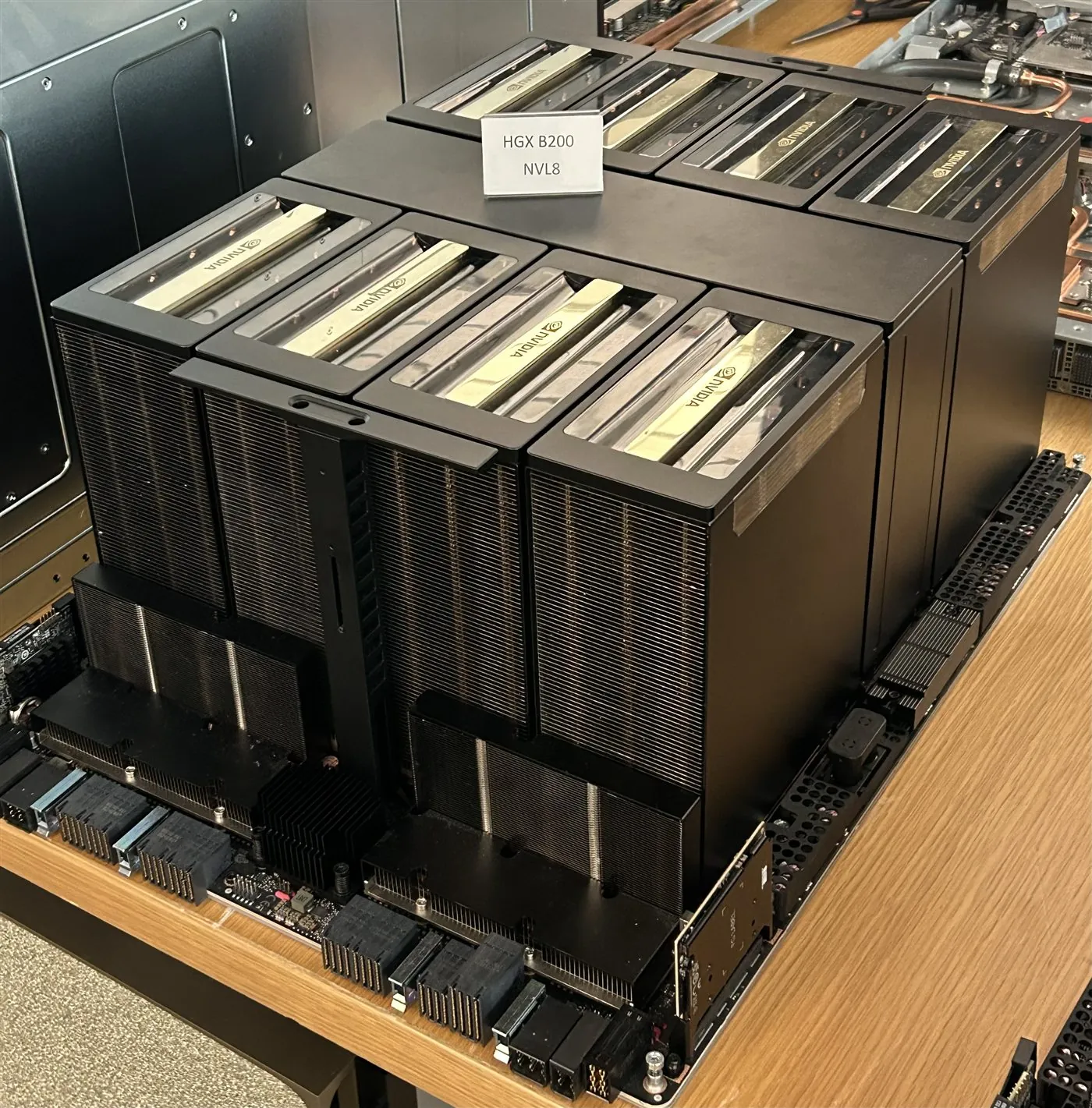
One node before the sheet metal: an 8-GPU NVIDIA HGX B200 baseboard. Photo: Pokiiri, via Wikimedia Commons (CC BY-SA 4.0). - NVLink, InfiniBand, and the fabric
- The wiring that makes many GPUs act as one computer. NVLink connects chips within a node (and, in rack-scale systems, across a rack). InfiniBand or specialized Ethernet connects nodes to each other. The fabric is why identical chips rent at different prices in different facilities: a training cluster is only as good as its interconnect, and the tier structure in published rates largely prices the fabric and the factory around the chip, not the chip alone.
- Rack-scale: GB200 NVL72
- The current frontier packaging: 72 Blackwell GPUs and 36 Grace CPUs cabled into a single rack that behaves as one machine, drawing roughly 120 kW, ten times a conventional server rack, and cooled by liquid, not air. Rack-scale systems collapse the distinction between “server” and “datacenter”: the rack is the unit of deployment, of pricing, and increasingly of collateral description.
-
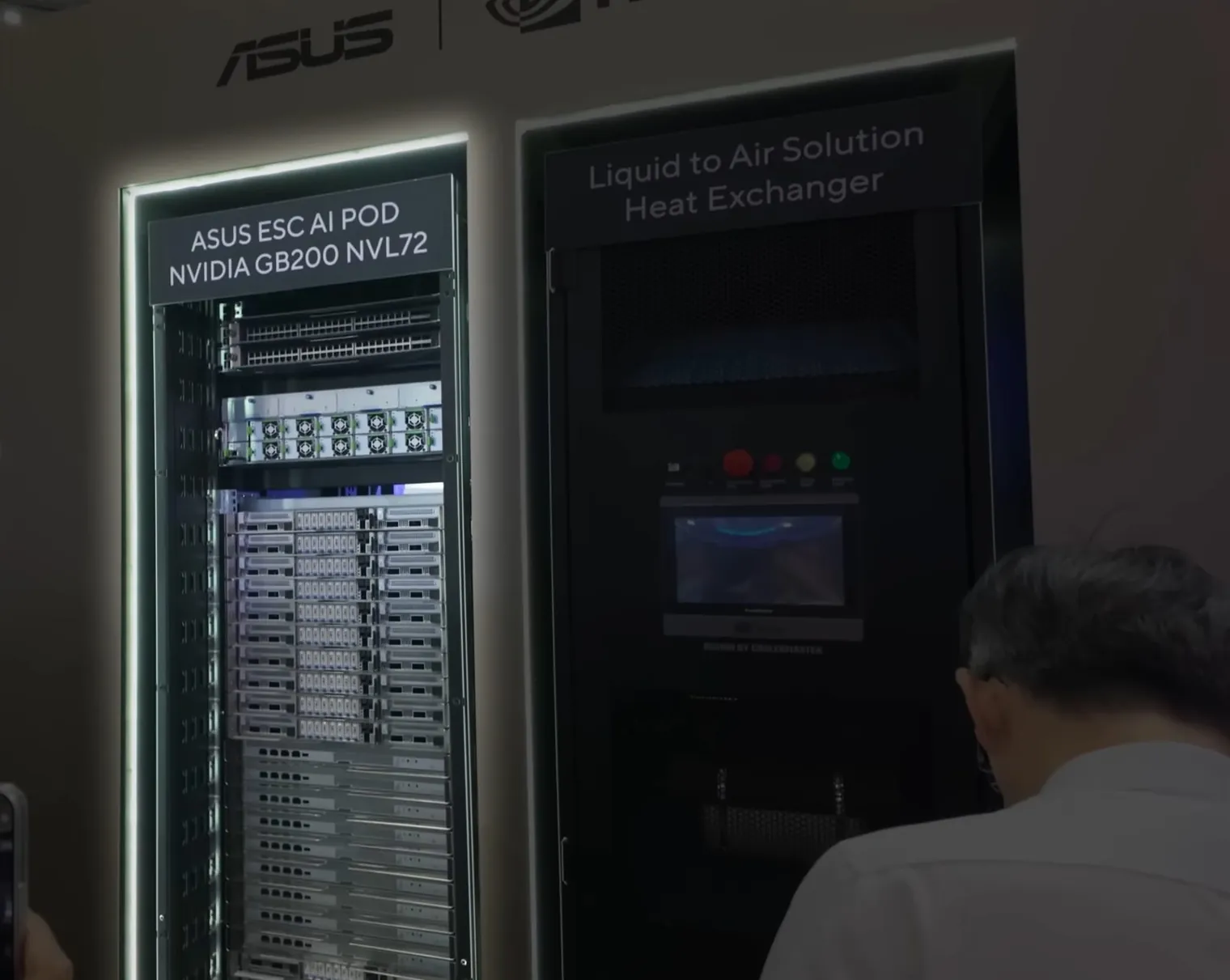
The rack as the machine: a GB200 NVL72 system displayed beside the liquid-to-air heat exchanger that cools it (COMPUTEX 2024). Photo: 极客湾 Geekerwan, via Wikimedia Commons (CC BY 3.0), cropped.
02 What the Spec Sheet Sells
- FLOPS
- Floating-point operations per second: raw arithmetic speed, the headline spec. Scale prefixes do the marketing: a teraFLOPS is 1012 operations per second, a petaFLOPS 1015, an exaFLOPS 1018. Two cautions for the finance reader. First, FLOPS figures are quoted at a stated precision (FP16, FP8, FP4: fewer bits per number means more operations per second), so headline numbers across generations are frequently not like-for-like. Second, peak FLOPS is a ceiling, not a forecast. See MFU below. What a rented FLOPS actually earns, per generation, is one of the four lenses at /chip-economics.
- Memory bandwidth (TB/s)
- How fast data moves between a GPU's memory and its compute, in terabytes per second. Inference work is usually limited by bandwidth, not arithmetic, which is why older GPUs with competitive bandwidth keep earning after their FLOPS have been eclipsed. In the current cross-section, rent per unit of bandwidth stays within a narrow band from A100 to B300, with no discount for age, while rent per FLOPS varies far more (Rent and Age). That reflects posted rents today. Blackwell chips also run FP4, a 4-bit format older chips lack, so inference that uses it gets more work per dollar from newer chips. Bandwidth is still the single most useful spec-sheet fact in this market.
- HBM / VRAM (GB)
- The GPU's on-package high-bandwidth memory, in gigabytes. The older usage calls it VRAM (video random-access memory). It gates which models fit on the chip at all: a model that doesn't fit must be split across more GPUs, multiplying the hardware bill. Mid-generation refreshes are often memory upgrades wearing the same architecture (H100 → H200), and they command a durable rent premium.
- Tokens / $ per million tokens
- The retail unit one level up: models read and write text in tokens (roughly three-quarters of a word each), and inference is sold by the million tokens. Token prices are to GPU rental rates what refined-product prices are to crude. The downstream margin decides what the upstream capacity can charge.
03 What the Facility Measures
- MW (megawatts)
- The unit large deals are actually denominated in. Datacenter leases and hosting agreements contract for power capacity (“up to an aggregate of 250 MW,” in the Applied Digital–CoreWeave leases) because power, not floor space, is the scarce input. A useful conversion for sizing: at roughly a kilowatt per current-generation GPU all-in, a 100 MW building hosts on the order of 70,000–100,000 GPUs.
- TDP (thermal design power)
- The chip's rated power draw in watts: roughly 700 W for an H100 SXM, 1,000 W for a B200, 1,400 W for a B300. TDP is the bridge between the chip and the facility: it converts a GPU count into the MW a lease must supply. It also denominates one of the cross-generation lenses at /chip-economics: rent per TDP-kilowatt-hour, the earning power of a watt delivered to silicon.
- PUE (power usage effectiveness)
- Total facility power divided by the power that reaches the IT equipment. A PUE of 1.2 means 20% overhead for cooling and distribution. Purpose-built AI facilities run roughly 1.1–1.3. Older enterprise sites run materially higher. For a finance reader, PUE is an operating-margin term: every point of overhead is power purchased but not resold as compute.
04 What Utilization Actually Means
- Utilization
- The share of a fleet that is rented rather than idle: occupancy, in real-estate terms. Because a GPU-hour is non-storable, unsold hours are revenue permanently foregone, not inventory. CCIR publishes fleet utilization and venue availability at /utilization.
- MFU (model FLOPs utilization)
- Of the arithmetic a GPU could theoretically perform, the share a training run actually uses, commonly cited in the 30–50% range for large runs. The gap is physics and plumbing: chips wait on data, on each other, and on the network. MFU is why revenue models built on peak-FLOPS arithmetic overstate what a cluster delivers, in the same way nameplate capacity overstates a power plant's output.
- Goodput
- Throughput that survives failures. Training runs on thousands of GPUs checkpoint their progress and restart when hardware fails. At scale, something is always failing. So useful output is what remains after restarts and lost work. Goodput is the engineering quantity behind the hardware-failure clauses in the filed MSAs, where two days of persistent failure suspends the payment obligation. Those contracts are what the credit agreements in The GPU SPV are underwritten against.
- Availability / uptime SLA
- The contracted promise that capacity is up and reachable, distinct from utilization (whether anyone is renting it) and from MFU (what the renter extracts from it). Service-level agreements (SLAs) convert downtime into service credits. Committed contracts convert extended hardware failure into suspended rent. Availability is a covenant term. Utilization is a demand fact.
05 The Workloads
- Training
- Building the model: a project-style campaign running near flat-out on thousands of the newest, fastest-interconnected GPUs for months, procured by a handful of counterparties under multi-year committed contracts. Training demand behaves like construction backlog: lumpy, concentrated, contract-wrapped.
- Fine-tuning
- Adapting an existing model to a task with modest additional training: days on dozens of GPUs rather than months on thousands. It transacts at short tenors and populates the middle of the market.
- Inference
- Running the model: every query, application programming interface (API) call, and AI feature in production. Recurring, usage-driven, latency-sensitive, diurnal, and tolerant of older hardware, which is what keeps prior generations earning. Inference demand behaves like utility load. The full credit translation is the subject of its own primer.
- Edge
- Inference that runs on the end device (phone, laptop, vehicle) rather than in a datacenter. From a compute-market standpoint, edge is demand that never rents a GPU-hour at all: capability shipped in consumer silicon rather than sold by the hour. Its growth shifts workload mix, not rental supply.
06 Reading the Numbers
Most of these terms exist on a spec sheet or in a facility plan. What connects them to credit is always the same move: divide the rent by the unit and watch the series. Rent per chip, per FLOPS, per TB/s of bandwidth, and per TDP-kilowatt is published daily at /chip-economics. Rates by chip, term, and geography are at /rates. What operators actually realize per GPU-hour, from filings, is at /realized.