When GPU Contracts Break
What happened when GPU contracts broke, from 38 cases in filings, court records and press reports. How fleets were re-let, what they earned after, and what protects a lender.
01 What the record shows
We searched filings, court records and press reports for GPU contract breaks, roll-offs and fleet sales from 2022 to 2026. We found 38 cases. Two more points:
- Three whole fleets changed hands as company deals: Paperspace to DigitalOcean, Voltage Park into Lightning AI, and Northern Data to Rumble.
- Most breaks were contract roll-offs or customer losses, not loan defaults.
02 After a big customer leaves
When a big customer leaves, the fleet usually stays in place. Two owners in our cases first rented theirs on demand, to many smaller customers. By October 2025, Northern Data said it was moving those spot buyers onto reserved contracts. With demand for GPU time strong, re-letting can sound quick. The steps below walk through what it takes in practice.
- Prepare the machines. The old customer's data and software are still on the servers. The owner erases the local drives to a federal standard, NIST SP 800-88. It checks the firmware, the low-level code under the operating system, so the next customer can trust it. It reinstalls the operating system and drivers. It changes the network settings so each new customer is walled off from the others. Then it runs every GPU under full load to catch failing parts before anyone pays. We estimate two to four weeks with no rent, while power and site costs keep running. At scale it can run longer. One large GPU cloud's IPO filing says that in a badly set-up cloud, "GPU acceptance, provisioning, burn-in and testing issues can take months."
- Change how the fleet is sold. Under a big contract, one customer takes the whole cluster for years. It often runs its own software on top and deals with the owner through one account team. On-demand service works differently. Many customers rent a few servers each, by the hour, and come and go. The owner needs software that hands out servers, bills by the hour and keeps each customer's data and traffic apart. It also needs support for many small accounts. A fleet built for one customer may have none of this. One owner in our cases moved two clusters from reserved contracts to on-demand service between December 2024 and February 2025. Its cloud revenue fell $9.9 million in a quarter. It said: "We encountered technical issues in moving the capacity which have since been resolved" (case). Another GPU cloud's IPO filing warns that its halls may not suit replacement customers "without meaningful retrofitting or upgrading."
- Fill it a block at a time. A big customer takes thousands of GPUs in one deal. On-demand customers rent a few servers each. Most GPU clouds we checked post prices for a few hundred GPUs at most and quote larger blocks on request. So a large fleet needs many customers to fill. Each one must be checked before it can rent. U.S. export guidance asks sellers of advanced chips to check who their customers are and who those customers serve. One owner with about 22,000 GPUs began rebuilding for on-demand access at the end of March 2025. Utilization was 11% in August, 62% in December and about 85% in March 2026 (case).
Larger fleets take longer. In our cases, about 2,048 GPUs earned little for about 5.5 months. A fleet of about 22,000 took about three quarters to be mostly re-let. A rack-scale system is rented a whole rack at a time, because its trays cannot run on their own (section 06).
03 The cases
Four cases show the paths in detail. Three fleets lost a large customer and re-let. One was sold as whole servers.
| Case | Fleet | Trigger | Time to re-let or sell | Yield or price kept |
|---|---|---|---|---|
| Northern Data | 22,352 H100 and H200 | Anchor customer, 91% of revenue, paid far less in 2025 (our inference: not renewed) | About three quarters | About 70% of the late-2024 yield by mid-2026 |
| Applied Digital | 6,144 H100; about 2,048 left idle | One of two tenants left; $9.5 million owed by a former customer written off | About 5.5 months | About two-thirds of the peak yield |
| SAKURA internet | About 2,000 H100 at the start | A large generative-AI contract was not renewed | About two quarters; utilization improved from October 2025 | GPU revenue per installed GPU-hour fell by about half |
| WhiteFiber | 126 H200 servers sold (1,008 GPUs) | $7.3 million unpaid at termination; WhiteFiber terminated the contract | 2 to 3 months to a signed sale; closed 3 to 5 months after termination | About 90% of the order price, 7% above carrying value |
Northern Data loses its anchor and re-lets 22,000 GPUs
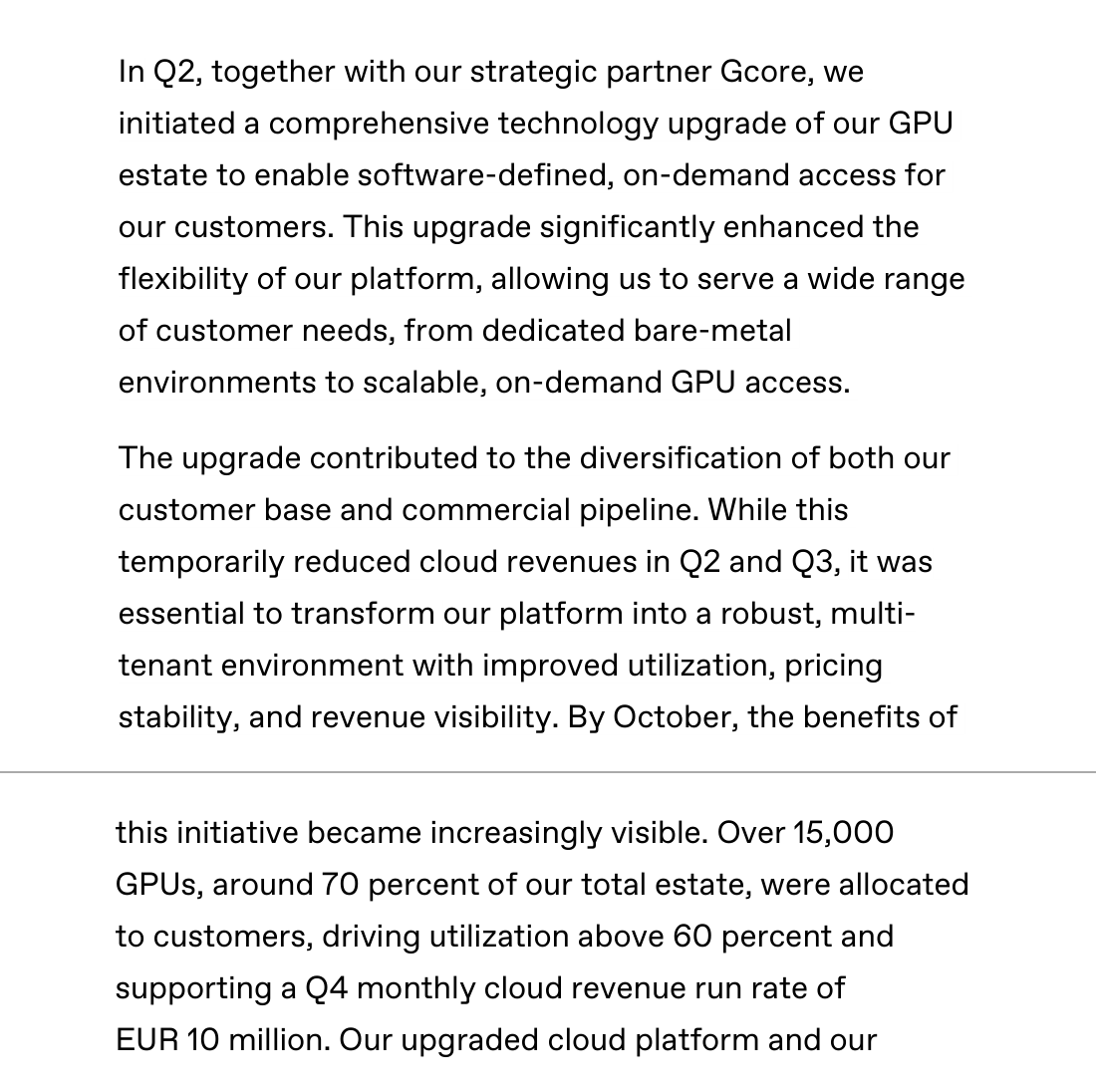
Northern Data's cloud unit, Taiga, ran 22,352 NVIDIA H100 and H200 GPUs in Europe. In 2024 one customer paid EUR 108.8 million, 91% of the unit's revenue, and no contract had more than twelve months left. In 2025 that customer paid EUR 38.2 million, less than Taiga earned in the first quarter alone. We infer its contracts ran out in early 2025 and were not renewed. Rumble's first bid, in May 2025, required a long-term contract with a customer that had historically paid a significant share of the unit's revenue. We take this to be the same customer. Northern Data's June counter-proposal dropped that condition. We found no replacement contract of that size for the Taiga fleet.
The owner moved the fleet to on-demand access and rebuilt around many smaller customers. Taiga's revenue fell from EUR 55.5 million in Q4 2024 to EUR 0.5 million in Q2 2025 while the platform was rebuilt. By mid-2026 revenue per installed GPU-hour was back to about EUR 1.11, about 70% of its Q4 2024 level. Taiga's first-quarter 2026 revenue passed the year before. The company wrote its GPU servers down by EUR 156.6 million, about 25%, and Rumble bought it in June 2026. Rising demand in 2026 helped.
| Quarter | Utilization (period filed) | Revenue per installed GPU-hour, EUR |
|---|---|---|
| Q4 2024 | n/a | 1.57 |
| Q2 2025 | n/a | 0.01 |
| Q3 2025 | 11% (Aug) | 0.16 |
| Q4 2025 | 62% (Dec) | 0.64 |
| Q1 2026 | about 85% (Mar) | 0.88 |
| Q2 2026 | about 85% (quarter) | 1.11 |
Revenue per installed GPU-hour: filed Taiga Cloud revenue divided by GPUs and hours. 22,352 H100 and H200 GPUs from 2025. About 16,000 at end-2024, a year-end count during the ramp that includes about 1,000 A6000 (Annual Report 2024, management report, page 40). So the Q4 2024 figure is a floor, and about 70% is an upper estimate. On a like-for-like count it is about 67%. Q4 2024 revenue is the full year less three filed quarters. Q2 2026 uses group revenue of about EUR 54 million. Utilization is filed mostly for single months. Q2 2026 is a quarter figure from RUM Group. n/a where none is filed.
Applied Digital Cloud loses one of two tenants
Applied Digital's cloud unit, now ChronoScale, ran 6,144 H100 GPUs for two tenants. One left in December 2024, and its GPUs (about 2,048) moved to on-demand service. They earned little for about 5.5 months. In fiscal 2025 the company also wrote off $9.5 million owed by a former customer. The other tenant, Together AI, moved its own 4,096 GPUs to new pricing from March 2025. From May 23, 2025, it also took the idle 2,048 month to month. Fleet revenue per installed GPU-hour fell from $2.06 to $1.34 and then $0.96. It then held near $1.36, about two-thirds of the peak.
SAKURA internet loses a large AI customer
SAKURA internet ran about 2,000 H100 GPUs at its Ishikari data center in Japan from August 2024, and about 2,840 by early 2025. In 2025 a large generative-AI contract reached the end of its term. SAKURA had expected it to renew, and it did not. GPU revenue fell 49% in one quarter, and SAKURA cut its full-year GPU forecast from JPY 15.8 billion to JPY 8.5 billion. It cut prices, sold through resellers and won several large deals. Utilization of its existing H100 and H200 GPUs improved from October 2025 to March 2026. It also added B200 GPUs.
WhiteFiber sells 126 H200 servers after ending a contract with $7.3 million unpaid
In December 2024 WhiteFiber (then Bit Digital) signed a 25-month order for 576 H200 GPUs with an AI compute fund run by DNA Holdings Venture. At the same time it ordered 130 H200 servers for about $30 million. Two more orders in April 2025 took the fund to 1,192 GPUs. In November 2025, with about $7.3 million unpaid, WhiteFiber terminated the agreement, and the fund agreed to repay. In the first quarter of 2026 it sold 126 H200 servers for about $26.1 million, against a carrying value of $24.3 million. We take them to be the fund's fleet, from the timing and the server count. It is the only case in our record with a filed sale price for the equipment itself. By May 2026 WhiteFiber had collected $2.2 million of the unpaid amount. Its August 2026 filing reports the same $2.2 million.

The filing calls the units "H200s GPU" in one place and "H200 servers" in another. A price of $207,000 per unit fits an 8-GPU server, so we read them as 1,008 GPUs.
| Measure | Per 8-GPU server | Per GPU, all-in |
|---|---|---|
| Purchase, Dec 2024 | about $230,800 | about $28,800 |
| Carrying value at sale | about $192,500 | about $24,100 |
| Sale, Q1 2026 | $207,000 | about $25,900 |
The price was about 90% of the December 2024 purchase price, 13 to 15 months after the order, and 7% above carrying value. They left as whole 8-GPU servers, which run in an ordinary air-cooled hall (section 06).
| Measure | Per GPU |
|---|---|
| WhiteFiber sale, Q1 2026 (whole servers, all-in) | $25,900 |
| CCIR H200 market value, 2026-11-11 (all-in) | $23,700 |
Our current H200 market value is below the sale price. It assumes a contract signed today at the current H200 contract rate of $1.75 per GPU-hour, against $2.14 for one-year deals in January 2025. The WhiteFiber price covers whole servers. The method is on /hardware.
04 Values under stress
These are CCIR's estimated stress-case values, based on the cases in section 03 and computed from today's market values on /hardware. The market values assume a contract signed today at recent contract rates. The case below starts from a default and follows the owner back to a new contract. It uses the same costs, utilization, decline and discount rates as the market value. It is a stated scenario. It is not a forecast.
- Default. The tenant stops paying today. The servers or racks stay in place.
- Time with no rent. The owner wipes and re-certifies the systems, finds tenants and runs acceptance tests. A larger fleet takes longer, and so does a system that few operators rent. We start at 3 months for 1,000 H100s. The time scales up with fleet size and down with the number of operators, from 3 to 12 months.
- New contract. The owner signs for the same term as recent contracts, at 65% of the recent contract rate. When the GPUs were leased to new customers, revenue per installed GPU-hour settled at about 50% to 70% of the earlier level.
- After it. The unit re-leases at published interruptible rates at 70% utilization, falling with age, until rent stops covering costs.
| System | Market value today (/hardware) | Stress range | Value kept | Months with no rent |
|---|---|---|---|---|
| B300 (HGX) | $85.3k | $38.4k to $47.0k | 45% to 55% | 3.9 to 12 |
| B200 (HGX) | $52.0k | $21.7k to $29.2k | 42% to 56% | 4.0 to 12 |
| H200 (HGX) | $23.7k | $7.6k to $12.9k | 32% to 55% | 3.4 to 11.4 |
| H100 (HGX) | $16.1k | $3.7k to $7.3k | 23% to 45% | 3.0 to 9.5 |
| GB300 NVL72 | $6.59M | $2.71M | 41% | 12 |
| GB200 NVL72 | $4.14M | $1.73M | 42% | 12 |
Each range runs from a large fleet (20,000 GPUs or 280 NVL72 racks) to a small fleet (1,000 GPUs or 14 racks). HGX figures per GPU, all-in. Rack figures per rack, on the same basis as the rack market values; racks reach the 12-month cap at both sizes. Northern Data re-let on demand and climbed back. This case locks in a contract at the lower rate, and for older chips that choice weighs on the result. Model outputs as of 2026-11-11. They are not prices.
Pool depth, time and price
The smaller the pool of buyers or tenants for a system, the longer it takes to place. Our inference: a thinner pool also means a deeper discount. A seller or lessor with few counterparties gives up price to place a fleet sooner.
What narrows the pool. Two things, and both tighten with each newer system. The first is the size of the ticket. At today's market values an 8-GPU H100 server is worth about $129k, a B300 server about $683k, and a GB300 NVL72 rack about $6.59M. Far fewer buyers or tenants can take on a whole rack. The second is the site. Air-cooled HGX servers run in ordinary halls. A rack-scale system needs a liquid loop and 125 to 155 kW per rack, and few halls have that (section 06).
The ticket grows with each generation. The cost basis per GPU went from about $40k for H100 in 2023 to about $46k for B200 in 2025 and $70k for B300 in early 2026. A GB300 NVL72 rack cost about $5.8 million in 2025.
| System | Cost basis | Modeled value today | Stress value, midpoint |
|---|---|---|---|
| H100 HGX per GPU | $39.7k (2023) | $16.1k | $5.5k |
| H200 HGX per GPU | $40.0k (2024) | $23.7k | $10.3k |
| B200 HGX per GPU | $46.0k (2025) | $52.0k | $25.4k |
| B300 HGX per GPU | $70.0k (2026) | $85.3k | $42.7k |
| GB200 NVL72 per rack | $3.65M (2025) | $4.14M | $1.73M |
| GB300 NVL72 per rack | $5.80M (2025) | $6.59M | $2.71M |
Cost basis: the purchase price of the servers and the network gear bought with them, the figure lenders test loans against. It excludes the building, power and cooling. From filed purchases and public awards by several buyers. GB200 has no filed purchase price; its cost basis comes from 2025 analyst estimates plus network, checked against the GSA schedule price. Market and stress values as of 2026-11-11, from /hardware and section 03 above.
Time to place, by path. The record shows how long each path took and what it returned.
| Path | Case | Time | Outcome |
|---|---|---|---|
| Re-lease in place | 9 cases (4 with a filed yield) | Under 1 month to about three quarters | H100 fleets re-let in 2024 and 2025 earned about 0.47 to 0.78 of their prior revenue per installed GPU-hour |
| Sale as whole servers | WhiteFiber H200 | 2 to 3 months to a signed sale; closed 3 to 5 months after termination | 0.90 of the order price, 1.07 of carrying value |
| Cluster offered for sale | Northern Data | Held for sale Dec 2025, withdrawn May 2026 | No sale. Carried at EUR 37.7 million, the lower of book value and fair value less costs to sell. Then impaired by EUR 1.2 million to fair value less costs to sell. Kept and redeployed within the group. |
| Whole company sold | Northern Data to Rumble | 12 months or more | Fleet moved in place with the company |
No case offers the same fleet at two prices. So the trade between price and speed is not measured. The stress case above builds in the time side: its months with no rent lengthen as fleets grow and pools shrink.
05 What protects a lender
A GPU lender usually holds four things. It rarely holds the building.
- A pledge of the shares of the company that owns the GPUs.
- A UCC-1 filing on the equipment.
- The customer contract, with its cash paid into accounts the lender controls.
- A guarantee from the parent, often limited.
More in The GPU SPV: How Lenders Take Compute as Collateral.
Lenders also plan for a replacement customer. IREN's Hardware 3 facility plans for one case: Microsoft rejecting a tranche before acceptance. The owner then has 60 to 120 days to sell the servers, move them to a later tranche, or sign a substitute customer. The substitute must be Amazon, Meta, Alphabet or NVIDIA, or guaranteed by one of them. The lenders and noteholders can approve another. The contract must cover the remaining term, keep the servers in the same data center and come with a direct agreement. The notes' rating must not drop more than one notch. If Microsoft ends the whole contract, it is an event of default.
Two things can weaken the lender's hold. Other claims can rank ahead of it: a vendor that keeps title until paid or an equipment lessor; property tax liens; landlord liens. And a lease that works like a loan can be treated as one. Our reading of 11 U.S.C. 365(d)(5): in bankruptcy the lessor then loses its right to rent payments during the case.
Where the GPUs sit
The lender holds the GPUs. Someone else holds the building, the power and the cooling.
If the host stops service or fails. The lender's lien stays on the equipment. A host that breaks or rejects its contract stops supplying power and space. The machines stay with their owner. The owner, and through it the lender, then has three options. It can agree new terms with the host to stay in place, move the equipment out, or sell it. In Nscale's filed loan, losing the host is an event of default, as losing a customer is. The cure is a replacement within 90 days, on similar terms the lenders accept, at the same site or another approved site.
Four things make that harder:
- Time. Hosting contracts set a period to remove equipment: 60 days after termination in one filed agreement, 10 days after a retrieval notice in another. Powered-down GPUs earn nothing and lose value each month.
- The host's own claims. A host owed fees may claim a lien on equipment in its building. Some filed loan agreements allow it. That gives the host leverage in any new deal. One filed hosting form has the host waive any lien on the client's machines.
- Bankruptcy. If the equipment owner is in bankruptcy, the lender needs the court's permission to take the collateral.
- Access. A lien gives rights to the equipment, but not entry to the building. Without an agreement with the host, removal depends on the host's cooperation.
The precedent, and how lenders plan for it
The precedent. In January 2023 the bankrupt host Core Scientific was allowed to reject its hosting contracts with Celsius, over about $7.8 million of disputed power costs. About 37,500 Celsius mining machines were powered down on January 3. The host deracked and packed them at its own cost, and Celsius had 75 days to collect them. By late April the host had signed new customers for almost 18,000 machines at the same sites. The two settled in September 2023. Celsius bought Core Scientific's Cedarvale site in Texas for $14 million in cash plus the release of its claims.
Servers and racks differ. HGX servers can be pulled and running in another hall within weeks, so a host failure costs time. A liquid-cooled NVL72 rack has few other halls to go to. A deal with the current host is often the only realistic path, so a host failure costs value (section 06).
How lenders plan for it. Filed deals use four tools:
- A direct agreement with the host. Such agreements usually require the host to warn the lender before cutting service, let it cure missed fees and let a new owner step in. IREN's Hardware 3 requires one before closing. CoreWeave's DDTL V asks only for commercially reasonable or best efforts. Nscale's Goldman loan asks for best efforts at its existing sites. It requires one at its Glomfjord site and at any new site, and later draws depend on getting them.
- A real-estate lease rather than a hosting license. A tenant under a lease that has started can stay if a bankrupt landlord rejects it. If the landlord stops its services, the tenant can only offset its rent. Our reading: a license may not give that protection.
- A backstop on the site lease. At TeraWulf, Google must step in if Fluidstack defaults or fails. It pays the rent due and takes over the lease, or in some cases lets it end and pays a termination fee. The backstop starts when each lease starts. That covers the building. The GPU debt has no such cover.
- Owning the site, or spreading the fleet across several hosts.
We found no case, through October 2026, where these were tested in the bankruptcy of a GPU host.
If it goes to enforcement. The lender's usual route is to sell the shares of the company that owns the GPUs, with the fleet and its contracts left in place. We estimate two to six months from default to a sale or a new operator out of court. In bankruptcy, enforcement stops on the day of filing, and we estimate a court-supervised sale takes two to four months.
06 Moving and reselling a fleet
How fast a fleet finds a new home depends on its form factor. That sets who can take it, and so how deep the pool is (section 04).
Re-letting in place is the fast path. A new tenant in the same hall needs the drives wiped, the systems re-imaged, the network re-partitioned and acceptance tests run. We estimate two to four weeks. No rent comes in, and site costs keep running.
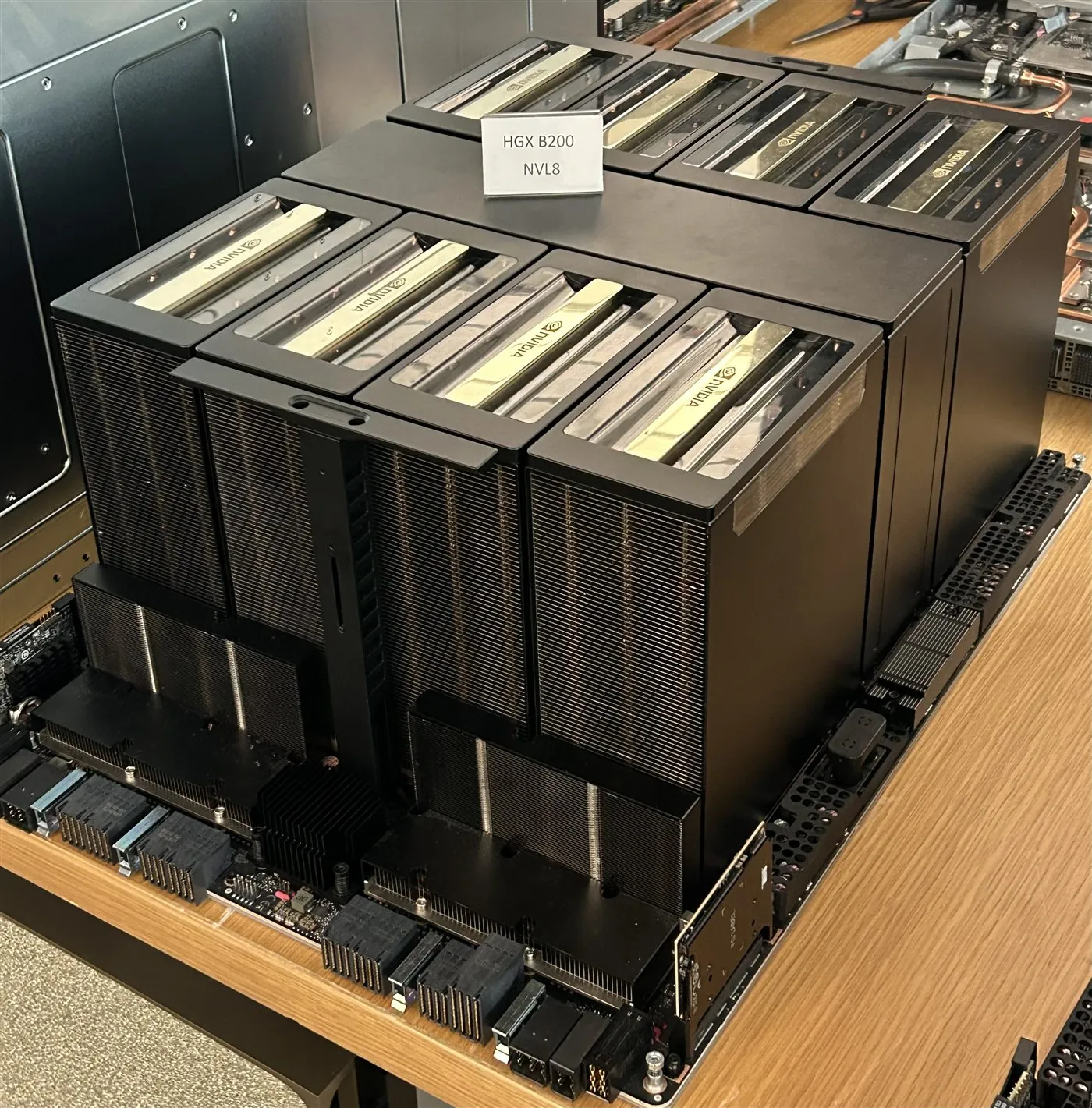
HGX servers split and sell one at a time. Each 8-GPU server has its own power and NVLink, and air-cooled Hopper and Blackwell run in an ordinary hall. Other GPU clouds, marketplace hosts and enterprises can take them. WhiteFiber sold 126 H200 servers within months, in one sale agreement.
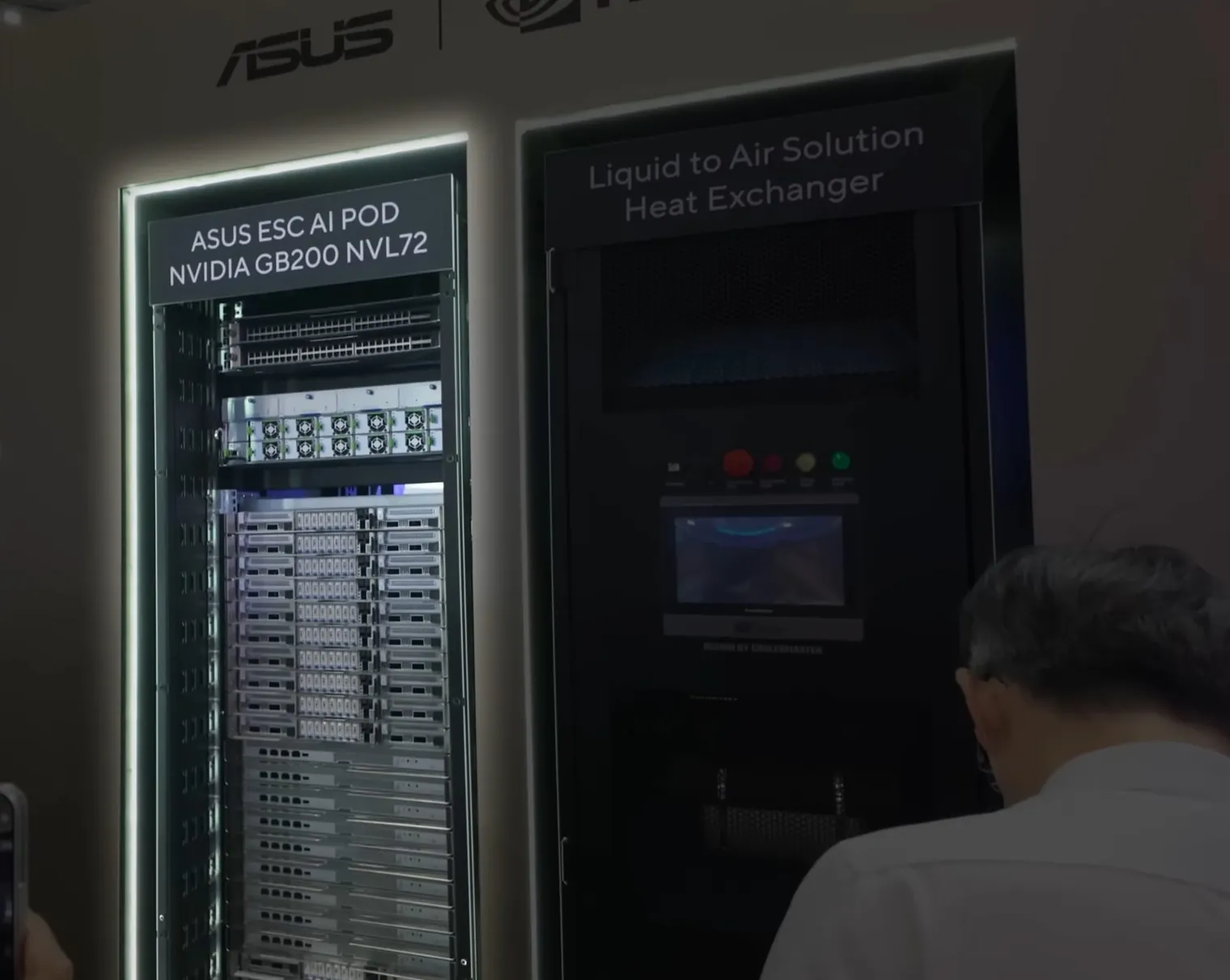
Rack-scale systems move only as whole racks. GB200 and GB300 NVL72 trays draw power from the rack and reach each other only through its switch trays. About 90% of their heat goes to liquid. Few halls can take a 125 to 155 kW liquid-cooled rack, and most are leased to the operators that built them. The pool is a handful of GPU clouds, or whoever takes over the site.
| HGX (air) | HGX Blackwell (liquid) | GB200 / GB300 NVL72 | |
|---|---|---|---|
| Unit of sale | 8-GPU server | 8-GPU server | Whole rack |
| Receiving hall | 20 to 60 kW air racks | Liquid loop and CDU | Liquid loop, CDU, 125 to 155 kW per rack |
| Buyer pool | Wide | Liquid sites only | Narrowest |
Moving a fleet is slow and costly. Labor, downtime and testing cost more than the freight. A liquid rack must be drained, shipped at 1.4 to 1.7 metric tons, refilled, leak-tested and re-cabled. Commissioning then takes two to three weeks. NVIDIA's warranty and software license do not pass to a buyer, and every sale needs export screening. For a rack-scale fleet, leaving it where it stands is by far the cheapest outcome.
In our cases, no hyperscaler bought used GPUs. They rented capacity, declined options, or appeared as creditors owed cloud bills. No case shows one buying hardware, new or used.
07 What it means for collateral
- The contract comes first. Lenders underwrite the customer contract and the cash it pays. The machines are the backstop.
- Re-letting in place is the path the record shows. When the GPUs were leased to new customers, revenue per GPU-hour settled at about 50% to 70% of the old level. Most old rates were set in 2023 and 2024, when H100 rental rates were higher. In 2026, CoreWeave said two customers renewed at term expiration. One H200 renewal was priced at a premium to the original contract. A three-year A100 renewal was priced in line with typical one-year terms. Time to re-let grew with fleet size.
- The stress ranges put numbers on that path. Section 04 applies a default, 3 to 12 months with no rent and a new contract at 65% of the recent rate to today's values.
- Form factor is a credit term. HGX fleets can split and sell server by server, into a wide market. Rack-scale fleets move only whole, to a narrow set of sites.
- For rack-scale systems, the site is part of the collateral. A lender that cannot keep the racks powered and cooled where they stand holds heavy, liquid-cooled machines with few places to go.
- The legal path is untested on GPUs. Section 05 sets out the usual route. The nearest precedents are Bitcoin mining fleets, and they went both ways. Some lenders kept a lien on miners that stayed in place, or took title where they sat. Others swapped their claims for stock, or took the machines back. In the one host bankruptcy, the host ended most hosting contracts. The Celsius machines were powered down and moved out, and other customers got theirs back.
For the method behind the market values, see /hardware. For how lenders watch a live contract, see /applications.
Method and sources
Cases: company filings (SEC, exchange and annual reports) first, then press reports, labeled as such, 2022 to 2026. We classify the 38 cases by what happened. In 16, the tenant broke its contract: default, insolvency, early exit or pivot. In 4, the owner or borrower hit distress. The other 18 are contracts that simply ended, renegotiations, the 2022 Ethereum Merge, voluntary mergers and sales, and four other events. Those four are a supplier non-delivery, a planned offtaker that left (OpenAI in April 2026), idle capacity in China and a vendor backstop.
Physical specifications: NVIDIA, Dell, Supermicro, HPE and Lenovo documentation. Legal structure: filed credit, lease and colocation agreements on SEC EDGAR, the Uniform Commercial Code, the U.S. Bankruptcy Code and public bankruptcy dockets. Export rules: 15 CFR 742.6 and BIS guidance of May 13, 2025. Industry capacity figures: Uptime Institute and JLL.
Values and the re-contract case: the CCIR hardware model as of 2026-11-11. Implied rates divide a filed contract total by GPUs and hours. Operator counts are on-demand price posts in the CCIR record as of September 26, 2026. Where a statement is our inference, the text says so. This note is market research. It is not legal, tax or engineering advice.
- WhiteFiber, Form 10-Q, quarter ended March 31, 2026 (H200 sale, DNA Fund, 10-server order). SEC accession 0001213900-26-056212. sec.gov
- WhiteFiber, Form 10-K, fiscal 2025. SEC accession 0001213900-26-034341. sec.gov
- WhiteFiber, Form 10-Q, quarter ended June 30, 2026 (DNA Fund collections unchanged at $2.2 million). SEC accession 0001213900-26-088026. sec.gov
- Bit Digital, Form 8-K Exhibit 99.1, March 14, 2025 (DNA Fund agreement, $20.2 million). SEC accession 0001013762-25-000323. sec.gov
- CoreWeave Financing DDTL V credit agreement, May 15, 2026, sections 5.19 and 5.20 (collateral access agreements and step-in rights letters), and Excepted Liens (i) and (j) and the Lien definition (permitted lease, contract and title-retention liens). sec.gov
- Nscale credit agreement with Goldman Sachs, Form S-1 Exhibit 10.14, sections 5.19, 4.02(g), 4.03(l) and 7.01(m) (loss of the host is an event of default, 90-day replacement cure) (best efforts at existing sites; required at Glomfjord at closing, at new sites and for later draws) and the Icelandic Contractual Rights Pledge Agreement definition (landlord step-in acknowledgment). sec.gov
- 11 U.S.C. 365(h) (a tenant's rights when a bankrupt landlord rejects a lease) and 365(d)(5) (rent under personal-property leases). law.cornell.edu · 11 U.S.C. 362 (automatic stay). law.cornell.edu
- WhiteFiber and Nscale colocation agreement, 10-K Exhibit 10.29. sec.gov
- IREN Hardware 3 credit agreement and common terms agreement, May 29, 2026. sec.gov, sec.gov
- Nebius and Microsoft statement of work, 20-F Exhibit 4.4. sec.gov
- Dell Financial Services, form of Global Framework Agreement dated April 17, 2026, with Nscale Ward County Borrower SPV, LLC (Nscale Form S-1, Exhibit 10.20), and the S-1 section "Dell Vendor Financing". sec.gov
- Rumble and Tether loan agreement, June 2026. sec.gov
- TeraWulf 8-K, August 2025, and Cipher 8-K, September 2025 (Google backstops). sec.gov, sec.gov
- Northern Data, Annual Report 2025 (Taiga Cloud revenue, GPU fleet, fourth-quarter allocation and run rate, note 3.1.1 on remaining performance obligations, EUR 156.6 million server impairment, cluster held for sale). northerndata.de
- Rumble Form S-4, 2026, Northern Data IFRS note 5.6 (revenue from one Taiga Cloud customer, 2025 and 2024) and background of the merger (May 2025 bid condition on a long-term contract with a significant customer; June 2025 counter-proposal). SEC accession 0001213900-26-042803.
- Northern Data, Q1 2026 interim report, Exhibit 99.2 to a Rumble 8-K/A (cluster sale withdrawn). sec.gov
- RUM Group, Form 10-Q, quarter ended June 30, 2026 (Northern Data acquisition; Tether GPU contract dropped on "near capacity" utilization). sec.gov
- RUM Group, Form 8-K Exhibit 99.1, August 10, 2026 (Q2 2026 results; GPU utilization about 85% for the quarter). SEC accession 0001213900-26-087234. sec.gov
- Northern Data, Annual Report 2024 (Taiga Cloud revenue, more than 15,000 GPUs live at year end). northerndata.de · Rumble Form S-4, 2026 (20,320 H100 and 2,032 H200 GPUs). SEC accession 0001213900-26-042803.
- Northern Data releases: H1 2025 financial update, August 11, 2025 (quarterly Taiga Cloud revenue). northerndata.de · Operational and capital markets update, October 21, 2025 (on-demand upgrade from the end of March 2025; 11% utilization in August). northerndata.de · Operational update, May 13, 2026 (62% in December, about 85% in March). northerndata.de · Q2 2026 results (ad hoc), August 7, 2026 (revenue about EUR 54 million). northerndata.de
- Applied Digital, Form 10-Q, quarter ended November 30, 2024 (cloud revenue $27.7 million). SEC accession 0001144879-25-000006. sec.gov · Form 10-Q, quarter ended February 28, 2025 (two clusters to on-demand; finance leases to five years). SEC accession 0001628280-25-017684. sec.gov · Form 8-K Exhibit 99.1, April 14, 2025 (revenue down $9.9 million on the move to on-demand; technical issues in moving the capacity). SEC accession 0001628280-25-017683. sec.gov
- CoreWeave, Form S-1/A, March 2025 (acceptance, provisioning, burn-in and testing "can take months"; DDTL 1.0 and 2.0 "unconditionally guaranteed" by the parent). SEC accession 0001193125-25-052207. sec.gov · Nscale, Form S-1, September 18, 2026 (replacement customers and retrofitting). SEC accession 0001193125-26-395475. sec.gov
- CoreWeave, Form 8-K Exhibit 99.2, Investor Presentation, September 2026, slide 10 (A100 and H200 renewals at term). SEC accession 0001769628-26-000429. sec.gov
- U.S. Bureau of Industry and Security, Industry Guidance to Prevent Diversion of Advanced Computing Integrated Circuits, May 13, 2025. bis.gov
- Applied Digital, Form 10-K, fiscal 2025 (cloud revenue $84.4 million). SEC accession 0001144879-25-000021. sec.gov · Form 10-Q, quarter ended November 30, 2025. SEC accession 0001144879-26-000006. sec.gov · Form 10-Q, quarter ended February 28, 2026. SEC accession 0001144879-26-000030. sec.gov
- ChronoScale, Form 10-K, fiscal 2026 (loss of a customer in December 2024, $9.5 million bad debt, 6,144 GPUs), with Exhibits 10.27 (March 1, 2025 pricing, 4,096 GPUs) and 10.28 (2,048 GPUs from May 23, 2025). SEC accession 0001628280-26-058018. sec.gov, Ex. 10.27, Ex. 10.28
- SAKURA internet, results presentations (Japanese): October 28, 2024 (about 2,000 H100 earning revenue). sakura.ad.jp · July 28, 2025 (large generative-AI contract ended; forecast cut; quarterly GPU revenue). sakura.ad.jp · January 30, 2026 (large deals won; B200 GPUs). sakura.ad.jp · April 27, 2026 (H100 and H200 utilization improved in the second half; price adjustments). sakura.ad.jp · July 28, 2026. sakura.ad.jp
- DigitalOcean, Paperspace acquisition release. sec.gov · Voltage Park and Lightning AI merger release. voltagepark.com
- Bitcoin mining precedents: Greenidge Generation, Form 8-K, January 30, 2023 (NYDIG takes title to miners that stay hosted in place; Exhibit 10.2 loan bars moving them without lender consent; Exhibit 10.4 hosting form, 10-day removal after a retrieval notice and the host's lien waiver). SEC accession 0001628280-23-001779. sec.gov · Core Scientific, Form 424B3, May 3, 2024 (NYDIG miners shipped back; hosted customers' machines returned; equipment lenders keep liens or take stock). SEC accession 0001628280-24-020733. sec.gov · Soluna Holdings, Form 10-K, fiscal 2024 (NYDIG forecloses on and repossesses miners). SEC accession 0001641172-25-001756. sec.gov
- Core Scientific and Celsius: hosting contracts rejected and rigs powered down, January 2023 (press). coindesk.com · Core Scientific re-hosts the space, April 2023 (press). coindesk.com · Core Scientific and Celsius settlement, September 2023. corescientific.com · Bankruptcy court records, In re Core Scientific, S.D. Tex. No. 22-90341: Docket 189 and 232 (rejection; rigs powered down January 3, 2023, with 75 days to collect them) and Docket 1236 and 1292 (settlement and Cedarvale sale, approved October 2, 2023). 189, 232, 1236, 1292
- Uniform Commercial Code 1-203 (lease distinguished from security interest). law.cornell.edu
- Uniform Commercial Code 9-609 and 9-610. law.cornell.edu, law.cornell.edu · NIST SP 800-88. nist.gov ·15 CFR 742.6. ecfr.gov
- Uptime Institute, 2024 Global Data Center Survey. uptimeinstitute.com · JLL, liquid cooling. jll.com
- HIVE Blockchain, corporate update post Ethereum Merge, October 12, 2022. newsfilecorp.com · HIVE Digital Technologies, Form 6-K, February 11, 2025: Exhibit 99.1, note 22 (GPU mining machines widely available as Ethereum miners shut down) and Exhibit 99.2 (fully depreciated A-series GPUs sold). SEC accession 0001062993-25-002116. sec.gov, sec.gov
- NVIDIA DGX H100 user guide. nvidia.com · DGX B200 SuperPOD data center guide. nvidia.com · Lenovo GB300 NVL72 guide. lenovo.com